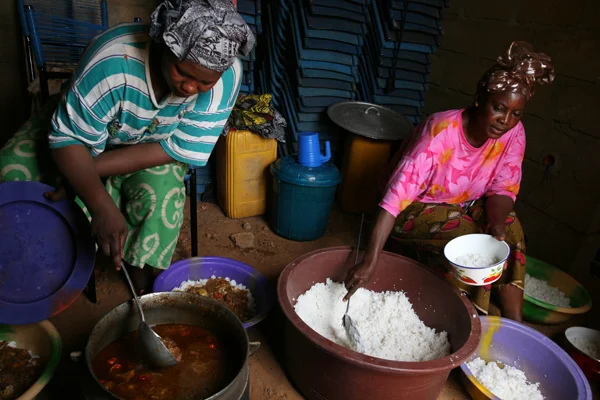
Friday lunch with the women and children of Sikoro

HIV-positive women are highly stigmatised. In Mali, one of the ten poorest countries in the
world, GAIA is a charity that funds treatment, education and training
to prevent HIV transmission during childbirth so that this scourge does
not extend to the next generation.

Every Friday in Sikoro, one of Bamako’s slums, lunch is cooked
and served by HIV positive women for HIV positive women and their
children. The activity draws many to the clinic, strengthening the
bonds of a highly stigmatised and marginalised community in desperate
need for support. They allow for shared experiences and education on
care and nutrition.

Continue reading

HIV care for the poorest of the poor

February 2, 2009.

HIV Care at the village level.

GAIA Vaccine Foundation has received permission from the Malian national AIDS agencies to establish the firt HIV care TB/HIV outreach program in a village clinic, located in Sikoro Mali. The new “Project Hope” HIV care center will open its doors on February 2, 2009.

Treatment for HIV and TB in peri-urban Mali, West Africa is constrained by extreme poverty and limited access to health care. Even though treatment for TB and antiretrovirals is free or low cost, few individuals are aware of the importance of treatment and even fewer have access to the centers where these lifesaving medications are distributed. Currently, only 18,000 of the estimated 180,000 Malians living with HIV infection have access to HIV care.

Continue reading

Turning somersaults in the dust

Dear friends of GAIA,

After a week in Mali, I have returned home. My body is here, but somewhere, behind my retinas, a change has taken place and my view of Providence has been irrevocably altered. I look at clean streets and solid sidewalks and bright streetlights and I miss the families that should be gathered there, sharing dinner by lamplight. I miss the children that – if this were Bamako – would be turning somersaults in the dust by the side of the road, the bicycles transporting crates of chickens, and the rows of chairs full of bodies watching soccer by communal TV. Driving down street after street here in Providence, there is not a single donkey standing in an intersection. There are no baskets of oranges, no stacks of brightly colored plastic teapots, no curtains of sneakers hanging by their laces from store fronts, by the side of the road. Crossing the bridge over the river, I do not compete for space with big green bashis filled to the brim with smiling people, who laugh at the slightest provocation and share smiles as we edge forward, in endless traffic together. Horns do not honk. Policemen do not whistle. Diesel fumes do not fill the air. This city, on this side of the ocean that divides us, is silent. It is night time in Providence. The people who live here are locked in their houses. The mullahs do not sing out the hours of prayer. Continue reading

So much better than just standing still

Hello

Another day in Paradise – although you’d be hard put to know it if you had just landed here from Mars. What makes this heady mix of mud, and joy, and neglect, and wild abandon into Paradise is so hard to describe.

To those who do not know it, Mali is a place where people get by on less than a dollar a day. Everywhere you look there are reminders of that – people in tatters, children in broken plastic sandals jumping over mud puddles and skirting piles of trash, carts and horses too seem to be held together with baling twine, cars that are older than the earth itself hobble along the broken tarmac, listing like so many overloaded boats. Children fly kites made of trash bags or push toy trucks made out of tin cans. Continue reading

Buckets of Mangoes

Well,

In case you were wondering why we are here, there is a reason.

Witness: GAIA volunteers Julie and Lauren walked with the TB Bolo educators out into the village, and after just visiting a few houses, discovered one in which a woman had been diagnosed with TB, had been “cured”, but her cough had come back – but she hadn’t been to the clinic to get it diagnosed (just based on the history, this is most likely TB). The TB Bolo educators gave her a GAIA ticket (which lowers the cost of her care at our clinic), and the next day she turned up at the clinic, where she was seen by our Dr. Kone, and where she will have her TB worked up. What does this mean? One case of TB taken off the streets; fewer of our HIV patients infected with TB; one more case of TB detected for the national Program. All very good outcomes for one day’s work.

Continue reading

Preventing death in childbirth

This article is from the New York Times. Pregnancy and childbirth kill more than 536,000 women a year, more than half of them in Africa, according to the World Health Organization.

In April 2009, GAIA volunteer Rebecca Gerber brought an ultrasound machine to Mali. GAIA VF is Part of the Solution. We Take Action.

Where Life’s Start Is a Deadly Risk
By DENISE GRADY

BEREGA, Tanzania — The young woman had already been in labor for two days by the time she reached the hospital here. Now two lives were at risk, and there was no choice but to operate and take the baby right away. Continue reading

What GAIA VF does that others don’t

Since 2005, GAIA VF has been providing Mother to Child HIV Transmission Prevention in Mali, West Africa.
This is the simplest, most direct means of preventing HIV. It is also incredibly low cost.

GLOBAL: Group Says Infants Needlessly Get HIV
Boston Globe (05.22.09) – Friday, May 22, 2009
Marilyn Chase, Bloomberg News

————————————————————————————————————————
Mother-to-child HIV infections have been almost eradicated in the global North, but prevention interventions are not accessible for the vast majority of HIV-positive women who will become pregnant in the developing world, according to an international coalition of HIV/AIDS advocates.

Continue reading

AIDS in Paradise

Friends of GAIA and friends of Mali –

It is true that GAIA is one of many foundations that finds itself in crisis at the present time, especially since promised funds from major foundations have failed to materialize, and it is true that the financial crisis is suppressing donations, and that as a result – despite our amazing progress and our ability to meet our goals – we don’t have enough money to see out six months – – but we are full of joy and optimism about our work in Mali. Why? Because we remain convinced, that we can do so much with so little. We will find a way, because there must be a way to do what needs to be done – to give a future to children who would otherwise have none, and to give hope for survival to their parents, AIDS patients who, without the simple meals and the medications we provide, would have given in, and given up, many months ago. Continue reading

Hope is a Vaccine on World AIDS Day 2008

In celebration of World AIDS Day, the Global Alliance to Immunize against AIDS (GAIA) Vaccine Foundation will honor the humanitarian work of seven noted HIV/AIDS advocates.

This year’s award recipients are:

*Daniel Halperin (Harvard University), for uncovering the connection between lack of circumcision and AIDS transmission and for advocating family planning and access to care as a low-cost means for stemming the spread of AIDS.
Dr. Halperin has conducted epidemiological and ethnographic research for over thirty years on a number of health and sociocultural issues in Latin America, sub-Saharan Africa and other developing regions. Since completing his doctoral training in medical and cultural anthropology at the University of California, Berkeley in 1995, his work has mainly focused on the heterosexual transmission of HIV and other sexually transmitted infections. He has had extensive involvement in the design, management and evaluation of prevention, care and other HIV-AIDS programs, and continues to be actively engaged in collaborative endeavors with UNAIDS, WHO, CDC, UNICEF, Gates Foundation and other international partners in developing and disseminating policy-setting technical consultations, guidance documents, etc. Continue reading

KAP studies in Sikoro Mali

Knowledge, Attitudes, Practices and Willingness to Participate in HIV Vaccine trials among urban residents of Bamako, Mali, in West Africa

Karamoko Tounkara1, Yssouf Kone2, Ben Aboubacar1, Ousmane Koita1, Sankare Moussa3,Dolo Ibrahima3, Siby Fanta3, and Anne S. De Groot4

1Fondation GAIA Mali, 2CSCOM de Sikoro and 3Direction Regionale de la Santé, Bamako, Mali and 4GAIA Vaccine Foundation, Providence RI

Continue reading