In Memory of Jesse W. Creel
January 20th 2012
Sheryl asks that you do not send flowers. Instead, please write her your remembrances, and you may donate to GAIA Vaccine Foundation here.
Please send your letters and expressions of regret to Sheryl and family at
6649 McKibbon Rd – North Branch, MI 48461
How we know Jesse:
Jesse was a brilliant, relentless advocate for people affected by HIV/AIDS. His mission evolved over the time that we knew him – a time so long ago, that we can probably date it to the dawn of the Internet. We became friends through AEGIS, a list serve that some may remember – a huge source of information about HIV treatment – before there was such a thing as a website.
Jesse was never stymied by lack of formal education and lack of access to the tools and techniques for making an AIDS vaccine. Despite these handicaps, he still made an enormous contribution, as a grassroots Internet advocate who championed AIDS vaccine research. He helped shape the hearts and minds of AIDS vaccine researchers, pushing and prodding them to think differently, to connect, and to reach across continents, so as to move HIV vaccine research forward.
Jesse Creel was also a keen collector and connector of people. When he thought it was important for one person to know another, because of their work or their thinking or their conversations with him (entirely by email), he made an introduction, and more often than not, research collaboration was born. He pointed out ideas that might have otherwise been obscured in the mass of printed literature. He informed, and – infrequently – opined.
When it was important, he raised the volume, and as a result, he had a direct impact on HIV vaccine research policy. His email updates to the global HIV vaccine research community garnered Jesse a devoted following, from the top echelons of Gates and the NIH to the front lines of the epidemic. He was self-taught, fearless, and tireless. His insights were at times startling, at times shocking, but always on point.
In Jesse’s own words – part of his application for a travel grant to the AIDS Vaccine Conference in Atlanta 2010:
I am a passionate HIV Research Advocate and have been independently researching and learning about immunology since 1984. I believe that the health status of individuals in poor nations is different from those residing in the wealthier regions, and it is therefore critically important to develop safe and more effective vaccines for the developing world. Over the past 26 years, I have thoroughly analyzed HIV/AIDS literature and consider myself to be well informed about the HIV epidemic. Since I am not formally trained in a university setting, I make my impact by circulating literature and media reports along with my comments to researchers who may have the ability to apply the knowledge to their laboratory work.
Focusing specifically on HIV-1 and global health, I make the effort to concentrate on material that is pertinent to vaccines as well as health care for developing nations. Literature that takes epidemics such as malnutrition, parasite infections, and other co-existing conditions into context are most fascinating to me. Promoting awareness of such problems creates a new sense of urgency to find a cure and to create new treatments.
Prior to Hurricane Katrina in 2005, I resided in New Orleans, where I worked as a bartender. Working as a bartender gave me the flexibility to study and research personal topics of interest, including theoretical physics/cosmology and HIV. During the Hurricane Katrina transition, I suffered a stroke related to congestive heart failure and am now retired from active work. I now dedicate my days to researching the HIV Virus and sharing my insight with hundreds of researchers by way of blast email. My contributions have been well received by many, and I will continue to make an impact as best as I can, for as long as possible. I hope to keep researchers focused on making vaccines that will be successful in the developing world context. I believe that if a vaccine is successful in a developing nation, then it should work well in developed nations where such problems are not as common.
What Jesse doesn’t mention, in this humble description of his work, is that he used his keen mind to move mountains. So many lose sight of the goal. Jesse never, ever, forgot why he was up late, reading, and making his humble contributions to the AIDS vaccine field.
For those of you who remember him, you will remember also his emails that were titled “PLEASE READ”. Like Alice in Wonderland. He was incredibly thoughtful, and would categorize his emails this way: TB: or Lyme: or Autism: or GRANT FUNDING!. He would throw a new paper or idea out, in his email, as if it were a pebble into the still water, and the ripples would carry that new idea across continents. Thus we learned about endogenous retroviruses, and new ideas about Alzheimer’s. Some people threw away his emails. I have all of them. Or almost all. They number more than 20,000.
For those of you who go as far back as I do, you will remember Jesse from before Gmail, before Katrina, when he was still working as a bartender. He used to use the email that you could get on your television with a keyboard (he did not have a computer at the time). He once explained his email address thus: Sheryl is my beloved wife. Buster was my nick name as a child, thus the email address SherylBuster@webtv.net.
In 2008, GAIA Vaccine Foundation gave Jesse Creel the Hope is a Vaccine Award for Advocacy. We said: Jesse Creel, grassroots AIDS advocate who has long championed the development of an HIV/AIDS vaccine, is a self-taught AIDS vaccine expert. Jesse is relentless in his pursuit of information about HIV vaccines and HIV treatments, scrutinizing each new piece of information as it is published for its relevance to individuals who are at highest risk of HIV and who, because of lack of education, poverty or distance, have no voice.
We will miss Jesse. He was a wonderful, unique human being. His life should remind us that anything is possible. He was a man as humble as the day is long, as brilliant as the best of them – who had a huge impact on so many minds, from the depths of the Michigan woods.
On that Day, we will not forget.
We will remember, and you will too, the sound of a mother crying, over a lost child.
We will remember too, the look of quiet desperation in the eyes of the young girl, who now knows that she is HIV-positive.
We will not forget the children left behind by the death of their parents, left behind with their grandmothers.
We will remember that the grandmothers were often the last ones standing.
We will remember, and you will too, the lines of patients waiting for medications, and our long talks with them, and the slow handfuls of pills that kept them alive, day-by-day, day-by-day.
We will not forget, we providers, instead, we will remember how few of our patients had medicine, how many could not get the test, or the x ray, or the pills.
We have parceled out hope.
We are both the caring, and the afflicted.
We will not, we cannot forget that there was a time when we could do nothing but give our hands and our hearts, and we cannot forget that once upon a time, our only salve was give solace.
At that time, we did not hold the cure.
But even worse, we did not have then, what we have now.
There is no more terrible time than now, to be caught, in this great imbalance, between those that possess the future – our patients – and those that do not – our patients by proxy, in the other places we work – whether prisoners, or indigent, or undocumented, or in Cambodia, on the Thai border, living in the underbelly of Nairobi, Capetown, or Mumbai.
Someday we will all- we will all remember this.
Because on that day AIDS will be a memory.
We will stand tall, as we do now, because we did what we needed to do. AIDS will be past. AIDS will be over. Because we, working together, will have made that future.
On that Day, we will celebrate the Future, without AIDS.
On that day we will not forget you, but we will miss you, Jesse Creel.
2011 World AIDS Day news
In the business world, people talk about “Return on Investment” or ”ROI”. What’s that mean? Well, usually it means – what’s the reward for the funds we invest? At GAIA Vaccine Foundation (VF) our ROI can be measured in smiles, in healthy babies who do not have HIV infection, in lives saved. What’s that ROI? Priceless. And unlike many not-for-profits, GAIA donor dollars go directly to programs. GAIA VF supporters have the satisfaction of knowing that lives can be dramatically improved, and the knowledge that, during the greatest pandemic in human history, GAIA is leading the way.

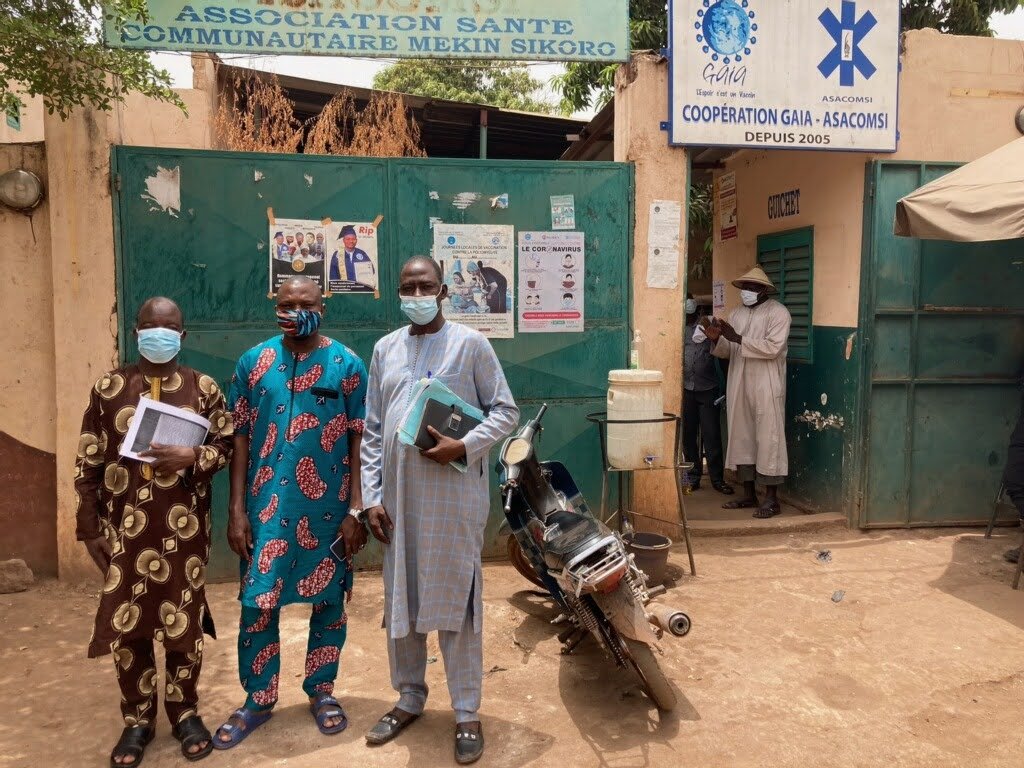
How so? We invested in building the Hope Center Clinic (HCC) in Mali in 2008 to make HIV treatment accessible. The clinic brings HIV medications right to patients in their neighborhood. We predicted that improving access would reduce HIV transmission and we were right! In fact, one of the key discoveries in HIV/AIDS in recent years has been that “Treatment is Prevention”. A study involving 1,763 HIV-sero-discordant couples (one partner was HIV positive, the other was not) was stopped before its original closing date because an interim analysis showed a 96% reduction in the HIV transmission rate (Cohen et al. NEJM 2011) and our World AIDS Day Press) – Cohen and Montaner are 2011 Hope is a Vaccine Award winners!
Based on the published data, our success at HCC, and the global trend to make HIV treatment available as a means of prevention, our next step is to provide Treatment as Prevention at HCC and follow its impact. In the absence of a vaccine, if providing access to anti-retroviral medication can eradicate AIDS, then we are ready to spring into action.
What does the new Treatment as Prevention finding and the call for Universal Access mean for the rest of the world? The gap between the number of people needing to be treated and the funds available to make that treatment accessible just got wider. Recent reports show, since 2009, a 7% decrease in philanthropic donations for AIDS. GAIA Vaccine Foundation’s achievements have proved that each donor’s support is critical to further our mission and improve access to HIV care and we are pleased to report that your donations allowed us to go above and beyond the objectives that were set for our program.
Volunteers are our strength! In 2010 and 2011, volunteers from all over the world helped with our programs in Bamako. Our volunteers, including Christina Gomez-Mira M.D. (U. Texas), Natasha Rybak M.D. (Brown U.), Emily Kossow (Wesleyan), Tonhu Hoang (Concord Academy) worked on the Mother-to-child HIV Transmission Prevention program (MTCTP). Nick Platt (American U. of Paris) worked on assessing adult HIV care with Ali Bicki (U. Miami), while Danielle Poole (Brown U. MPH program) and Shala Yekta, Ph.D. (URI) worked on the new HPV vaccine studies. We completed an evaluation of our MTCTP program (started in 2005) and data from the past 30 months of our universal access (HIV treament) intervention in Sikoro have been analyzed. We are happy to share a brief snapshot of the many positive events this year, with you.
Assessing our PMTCT Program
A survey of 28 HIV-infected mothers and babies attending the GAIA VF “Chez Rosalie” pre-natal program was performed.
We provide HIV transmission prevention to all HIV+ mothers who are willing to take ARV medications. The good news? Only one child out of 30 tested was infected by HIV. (1/3 of babies would have been infected without our intervention). The mothers report that they are very satisfied with the care that they are provided at Chez Rosalie. A second study is in progress that identify risk factors for transmission. Our results will be submitted to the World AIDS Conference (Washington DC, 2012).
PMTCT in numbers (2005-2011)
10,150 Mothers in prenatal care
9,060 Mothers tested for HIV
198 Mothers diagnosed with HIV
156 Newborns in Pediatric clinic follow up
Evaluating our HIV care Program
We recently evaluated the efficacy of HIV treatment with “triple therapy” in terms of AIDS-related infections, changes in weight, and T cell counts over a 30-month study period. More than 60% of the patients increased their weight and T cell counts and the percentage of patients with opportunistic infections due to AIDS was significantly reduced.
2011 Hope Center Clinic Achievements
200 HIV-infected adults and children in care
20 Newborns tested by PCR for HIV
37 Children in care
86 New HIV+ patients on treatment
830 Patients received nutrition support
62% improved their viral load while under ARV
61% of patients had opportunistic infection (OI) at beginning of therapy; almost all improved: less than 17% had OI after 7-15 months
HPV vaccine Project – Preparing for HIV Vaccine Trials
Danielle Poole, with help from Kate Tracy, U. Maryland, carried out a study to evaluate whether women (and men) in Mali are ready to accept vaccination with the newly approved HPV vaccine that prevents cervical cancer in women and genital warts in men.
The HPV study, supported in part by a research grant from Merck, will enable GAIA VF to collect information that is necessary prior to performing a clinical study with the Gardasil vaccine in Mali; a clinical trial is anticipated for next year. GAIA field personnel are currently developing the necessary protocols and infrastructure for such studies. Our goal is to lay the foundation for future HIV vaccine trials in Mali.
HIV Vaccine Program Focus of Bio-Defense Project
HIV a bioterror weapon ? Not exactly, but the Department of Defense is looking into the vaccine technology underpinning the GAIA HIV Vaccine and DoD is very interested in providing support for the next phase in GAIA VF vaccine development program. Stay tuned for the announcement on our cutting-edge HIV vaccine research!
2011 Hope is a Vaccine Award
Our “Hope is a Vaccine” award will be announced on World AIDS Day. See our “News and Events” section for more details. This year the award celebrates “Treatment as Prevention”.